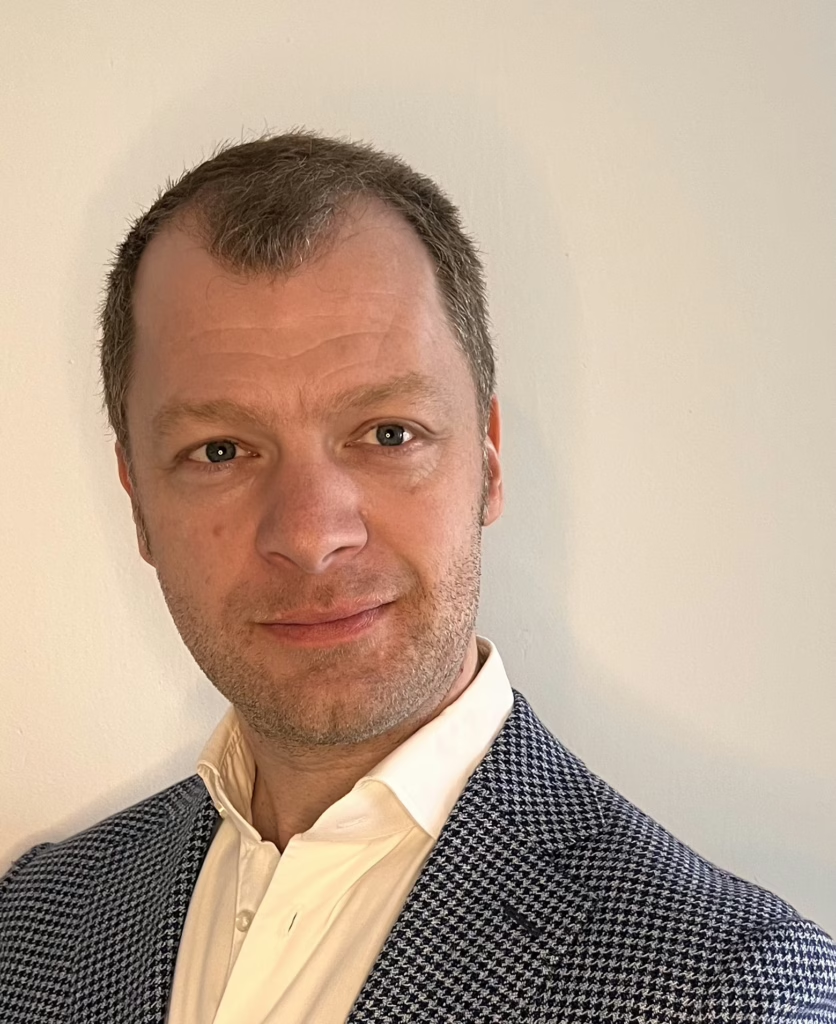
By Victor Broers, March 2026
The global order is not simply shifting, it is fragmenting. For decades, executives could operate within a relatively stable geopolitical and economic framework, shaped by rules-based trade, predictable alliances, and the implicit security guarantee of American leadership. That world is receding. What is emerging in its place is less coherent, more transactional, and far less predictable.
For leaders in the Dutch Caribbean, this transformation is not a distant abstraction, but immediate, material, and deeply consequential.
A central driver of this shift has been the changing posture of the United States. Under Donald Trump, the U.S. accelerated a transition that had been underway for years: from steward of the international system to a strategic actor primarily focused on advancing its own national interests. Alliances have become more transactional, trade policy more assertive, and multilateral commitments increasingly conditional. While personalities and administrations may change, the underlying trajectory appears structural. American foreign policy is becoming less predictable and less anchored in maintaining global stability as a shared good.
Power over rules: a new global reality
Meanwhile, the authority of organizations such as the United Nations and the WTO, which were designed to provide a framework for global cooperation, legitimacy, and conflict resolution, is increasingly contested. Major powers act outside established norms with greater frequency, enforcement mechanisms are weak or selectively applied, and international law itself is losing some of its constraining force.
The consequence is a gradual but profound shift toward a more power-based order, in which influence, geography, and economic weight matter more than formal rules. For small and mid-sized economies, this represents a structural challenge. International law has historically functioned as an equalizer. Its erosion increases exposure to unilateral decisions and external shocks.
Energy markets in flux
Nowhere are these dynamics more tangible than in global energy markets. The oil system, long one of the foundations of globalization, is undergoing simultaneous disruption. Sanctions regimes are reshaping supply chains, geopolitical rivalries are fragmenting markets, and countries are rethinking their energy security through a more regional lens. Volatility in pricing and logistics increases, while investment patterns are shifting accordingly.
Within the Western Hemisphere, these forces are driving a partial reconfiguration of oil flows and refining capacity. The Caribbean basin, once a central node in global refining and transshipment, is regaining strategic relevance. Shifts in crude sourcing, combined with geopolitical constraints elsewhere, are creating renewed demand for flexible refining, storage, and blending capacity closer to end markets. At the same time, the United States is placing greater emphasis on hemispheric energy resilience, further reinforcing regional dynamics.
For many oil companies & refiners, operating in or around the Dutch Caribbean, this creates a paradoxical landscape. On the one hand, uncertainty is increasing, around feedstock availability, regulatory environments, and geopolitical risk. On the other hand, opportunity is expanding. Assets that were once considered peripheral may become strategically valuable again, precisely because of their location and flexibility within a fragmenting system.
Geopolitical literacy at the core of decision-making
This points to a deeper shift in how strategy itself must be conceived. The question is no longer how to optimize within a stable system, but how to remain resilient and relevant within an unstable one. Efficiency, while still important, is no longer sufficient. Optionality – having multiple pathways, partnerships, and capabilities – becomes a central strategic asset.
For executives, the fracturing global order requires a fundamental broadening of perspective. Geopolitical literacy must move from the margins to the core of decision-making. Scenario-based planning becomes essential, as linear forecasts fail to capture the range of possible futures. Diversification of markets, suppliers, and alliances becomes a hedge against volatility. And perhaps most importantly, strategic positioning regains importance. In a fragmented world, where you are and how you are connected increasingly defines your raison d’etre.
In this context, the Dutch Caribbean occupies a uniquely promising position. Geographically, it sits at the crossroads of major shipping lanes and energy flows. Economically, it retains deep ties to the Americas, while politically connected to Europe. Historically, it has played a significant role in energy logistics, an inheritance that may once again become highly relevant in today’s world.
This combination creates an opportunity not merely to adapt to global change, but to actively reposition within it. The region can evolve into a strategic hub for energy, logistics, and transshipment in the Western Hemisphere. It can offer stability in a region often characterized by volatility. And it can serve as a bridge between different economic and political spheres.
From risk to opportunity: shaping the Caribbean’s future together
Realizing this potential, however, is not automatic. It requires alignment between public and private actors, investment in infrastructure and capabilities, and a willingness to move beyond legacy models that were shaped by a very different global context. For executives in the Dutch Caribbean, these times are not simply a moment of risk, but also of strategic possibility. The region is no longer at the periphery of the global system, it is increasingly at one of its fault lines. And in a fragmented world, those fault lines are precisely where new value – and new leadership – can emerge.
This is why, at the end of May (Curaçao) and the beginning of June (Sint Maarten), we will bring together executives and supervisory board members from both public and private organizations, at the Caribbean Executive Summits ‘Leadership in an Unravelling World Order’. Over the course of two days we will deep dive into the dynamics of the changing global order, and explore what risks and opportunities lay in front of us. In carefully curated closed sessions we will discuss new ways of cooperation and discuss how to increase strategic autonomy and resilience in times when the Dutch Caribbean become ever more relevant.
So join the summit and secure your seat at the table!
Curaçao, May 28 and 29: www.crmlink.nl/cur-2026
Sint Maarten, June 2 and 3: www.crmlink.nl/sxm-2026